Showing posts with label london. Show all posts

Monday, September 18, 2006

Ecstasy


‘It is through the cracks in our brains that ecstasy creeps in.’
Logan Pearsall Smith
The ecstasy in this collection, Ecstasy: Three tales of chemical romance may refer to the drug but this is only superficial and has layers of complexity huddled into them. Irvine Welsh (Trainspotting, Glue, Porno), it has to be said, is exclusively a rave-writer and as such most of his works observe the abyss of drug-users and how the pull of this abyss often has varying results. Thus, each of the three novellas in this collection have completely independent focus and in each Ecstasy acts only as a flashlight in searching for ecstasy.

In Lorraine goes to Livingston, a best selling author in the romance genre is left paralysed and bed-bound. She plans revenge on her cheating, gambling and whoring husband with the help of her nurse, Lorraine. This story has some Will Self bizarreness to it in the way it grotesquely parodies trashy paperbacks and tells of necrophilia in the hospitals under full knowledge of the supervision.

Fortune’s always hiding tells of a young couple, a deformed woman and her criminal lover, and how the take revenge against the corporate goons who deformed the beautiful lady for life with a thalidomide-like drug.

My favourite novella in the collection and the one which is true to its ‘tale of chemical romance’ tagline is this third and last one: The Undefeated. It tells of a couple, yuppie Heather and raver Lloyd, who fall in love while doing E at raves and parties. It is written alternatively between the two lovers so as to present each one’s side of the story and understanding of the drug culture not just a whole but to each gender, group and class. As the two discover each other soon their love of Ecstasy is transformed into the ecstasy of Love.

Comparisons will surely be made here with Trainspotting, Welsh’s most famous work that deals similarly with the drug culture in Leith and Edinburgh, but readers should remember that the drug in question here is Ecstasy and not Heroin. As anyone that has taken ecstasy would know, the drug makes you energetically confused and fuming for more and more unlike heroin. Heroin is a very slow drug that is depreciatingly smooth and makes one very, very immobile. Thus, Trainspotting may have had its slow grins but Ecstasy has its melting laughter. Music plays a very important role in the E-couture so when one reads The Undefeated, one becomes very aware of the musical environment and the nightclubbing that was absent in Trainspotting where the characters were too busy burning out as opposed to going out. However, the collection does posses Welsh’s familiar Scottish phonetics and black humour.

Give it a go. You may not easily find the drug (you may be looking in the wrong places) but the book is a best-seller and can be purchased by pressing the link below. If only E was as easy to come by.

Monday, August 21, 2006

The Picture of Dorian Gray


All art is quite useless.’
Oscar Wilde

This tale of macabre desires is one that has troubled me a lot and not because of what many criticize it for: homoeroticism. The homosexual tendencies of the story may have upset the critics and reading masses of the 19th century but this is no real cause for upsetting a 21st century person. To look around these days and study your environment, you’d think that the cupid is a real bad shooter. The gay culture has sprung out with such independence recently that to think that Oscar Wilde was ultimately sentenced to hard labour only because he had put together sentences in The picture of Dorian Gray is quite laughable. For those of you who are foolish and bigoted enough to overlook this classic piece of literature because of the homosexual bender (no pun intended) (well, ok, maybe just a little), you are better off reading these Oscar Wilde trial proceedings and going to sleep telling yourself that he really had it coming.

To those who have heard of the book and not yet got it or made up their mind, Hello.

The picture of Dorian Gray tells the story of (duh) the picture of Dorian Gray. Dorian Gray is a young man who poses and is much adored by Basil Hallward, an artist. Basil is much in awe of Dorian because of his infantile personality and innocent outlook of life. He recons that the best portrait he has ever painted is that of the handsome Dorian and discloses this confession to Lord Henry Wotton, a friend. Lord Henry is quite the corrupting serpent and it’s his cynical and hedonistic advice, ‘the only way to get rid of a temptation is to yield to it…resist it and the soul grows sick with longing’ that breaks Dorian’s virtue. He explains to Dorian how when his youth turns to age, his charm would be lost and time in its jealousy would wipe out every merit he contains. This really disturbs Dorian because he suddenly finds himself under the avalanche of words and time. So disturbed is he that when he is shown the completed portrait of himself, he speaks as if in a trance, hypnotized by the painting:

"How sad it is! I shall grow old, and horrible,
and dreadful. But this picture will remain always young.
It will never be older than this particular day of June.
. . . If it were only the other way! If it were I who was
to be always young, and the picture that was to grow old!
For that--for that--I would give everything! Yes, there is
nothing in the whole world I would not give! I would give my soul
for that!"

And it is really his soul that he has to part with in order to make the arrangement mentioned above. For, the new hedonist and aesthete breaks the heart of a poor actress that he was in love with, Sibyl Vane, and upon going home finds that his mad wish has come true; the painting before him gets a cruel feature to it once his cruelty to Sibyl was undertaken. He is delighted but loses this delight when he finds out the next morning that his spite with Sibyl made the poor girl commit suicide.

Lost of the true love that he saw in Sibyl, Dorian gets a mad streak of sin in him and goes on to commit every form of indulgence that London could offer him. He hung around opium dens, had apparent sexual relationships with young boys and saw them dishonoured, commits murders (one of them Basil’s) and still manages to retain his youth. However, there is a horrifying end to the tale as things don’t go as planned and Dorian gets the bitter end of his contract with an invisible devil.

The book troubled me, like I said, not because of the horrid vices that Dorian undertakes but because of the extent to which Dorian can go back home and not be troubled by seeing his aging and depreciating portrait. All of us face ourselves in the mirror everyday and even this brief acquaintance with ourselves sends us packing to mountains, fitness-centres, barbers, schools, doctors and so on. This is because all too often, it is far too unfair to look at ourselves eroded by time. In this light, to imagine a murderer, a criminal, a rapist and snob (all rolled into one) and scrutinize his decaying soul is something which is quite unnerving because he is all too aware of his ageless beauty and the powers it entails. Dorian lived a double-life like Jekyll & Hyde but here the horror is sharper because he doesn’t lose control of his personality for one minute and has the precision of a cold-hearted man.

Many of us have thought of Faust like pacts with the Devil once we see the supremacy it could bring us. The picture of Dorian Gray is an important work because it has no such Devil, Dorian always had the choice to redeem himself by stopping but he chose not to do so, which, truth be told, most of would have done as well.
Instead of making you walk in the shoes of a troubled man…the book makes you walk in the shoes of the Devil himself.
The Devil that is Man.

Dr. Jekyll and Mr. Hyde


If a man harbours any fear, it percolates through all his thinking, damages his personality and makes him landlord to a ghost.’
Lloyd C. Douglas

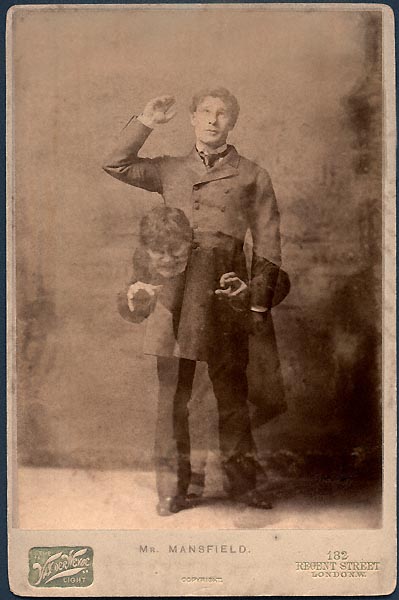
It is widely rumoured that Robert Louis Stevenson had written The Strange case of Dr. Jekyll and Mr. Hyde in a single six day-and-night cocaine binge. As much as I would like to credit cocaine for this work of genius (myself being an…ahem…use-), the fact is that Stevenson was a gifted writer even minus the powder and secondly, his own apparent use only adds to the strangeness of the strange case in the novel.

The term ‘Jekyll and Hyde’ has come down the decades as a very common one. Anyone with an unpredictable and altering personality is said to have a ‘Jekyll and Hyde’ syndrome. However, though the term and its eventual understanding has been portrayed in so many plays and movies (Fight Club, American Psycho, Nutty professor, The Hulk, Star wars to name a few…) most people don’t bother to read the novel that started it all because they think they already know the premise. Now this, I must say, is something that Hyde himself may have done.

It’s true that superficially the novel is about one Dr. Jekyll who is a respectable citizen of Victorian London and in good circles of the immediate society but who also has a secret alter-ego that is quite unlike him: Mr. Hyde. Thus, Jekyll = good while Hyde = bad. This is where most people who have been handed down the plot assume that there may be little to read between these lines. Actually, there is a lot.

The horror presented to readers in this short and clear tale is not of one man having two personalities but of two personalities having one man. Think about it. How many times have you told lies or caused harm to someone, all the time knowing that it was bad? The guilt of the doer hangs to him like a moth circles a light bulb. This guilt or conscience is the burning proof of man’s duality for if man didn’t have two natures then there would be no guilt. Like Jekyll himself comes to tell in the novel, ‘With every day, and from both sides of my intelligence, the moral and theintellectual, I thus drew steadily nearer to that truth, by whosepartial discovery I have been doomed to such a dreadful shipwreck: that man is not truly one, but truly two.’

It is one thing to wake up the next morning and face the remorse of a crime or an evil deed carried out by yourself but something quite another, and infinitely worse, to know that this evil has been carried out not by your own nature but another independent disposition of your spirit that just happens to share the body you inhibit as well. Two is company, three’s crowd but this simple phrase can’t be applied to the human body because here, even two is a crowd; a stampede of decisions and impulses. The strangeness of the case resides in the magical potion that is used by Jekyll to transform into Hyde.

In his younger days, Jekyll had questioned and then come to the conclusion that man has a dual nature and to take this theory into practice, he creates a potion that embodies the two aspects of a man into different mental and physical faculties. This brings out a metamorphosis of sorts that sees Edward Hyde getting a bigger share of the pie that is the shared body. Hyde goes out into the London night to commit all the anti-social pleasures that Jekyll cannot. Soon, the evil nature gets such a predominant role in Jekyll that he completely transforms into Hyde and has to lock himself away from the attendance of worried friends and staff. A conclusion or decision has to be arrived at to see what happens with the mental Siamese-twins that are Jekyll and Hyde and it is this conclusion that I will leave for you to find out.

If you have ever experimented with cocaine or even a little grass, you may find the tale rather interesting. While using these drugs (which for me substituted the magic potion cited in the tale), my interest into the subject matter was quadrupled with the common paranoia and artificial pleasures that these substances release. But of course, one need not participate in drugs to love the tale. The only potion you need is a little faith in yourself and the motion to destroy exactly that.

Sunday, August 06, 2006

I, Lucifer


…Just as every cop is a criminal
And all the sinners saints
As heads is tails
Just call me Lucifer
Cause I’m in need of some restraint
So if you meet me
Have some courtesy
Have some sympathy, and some taste
Use all your well-learned politics
Or Ill lay your soul to waste, um yeah…

-----Sympathy for the Devil, Rolling Stones-----


Milton took it upon himself to ‘justify the ways of God to men’ and through I, Lucifer Glen Duncan (Hope, Weathercock) attempts to justify the ways of Lucifer to those interested in the other side of the story. In literature and in popular belief, few have tackled this other side and an endeavour like Duncan’s is bound to be seen as controversial and gimmicky but the novel has enough hilarity in it to rescue itself from both.

‘I, Lucifer, Fallen Angel, Prince of Darkness, Bringer of Light, Ruler of Hell, Lord of the Flies, Father of Lies, Apostate Supreme, Tempter of Mankind, Old Serpent, Prince of This World, Seducer, Accuser, Tormentor, Blasphemer, and without a doubt Best Fuck in the Seen and Unseen Universe (ask Eve, that minx) have decided - oo-la-la! - to tell all.’

These are the opening lines of the novel and are in stark contrast to the start of The Master and Margarita by Mikhail Bulgakov, which features a Satan of an allusive introduction. This David Copperfield sort of launch serves an important purpose as the reader is gripped by the no-nonsense-beating-around-the-bush start. A lot of books and movies about the Devil come to the protagonist’s realm only eventually as it is a touchy subject and a particular upsurge is required to build anxiety in the eyes of the reader. But I, Lucifer doesn’t want to target the mind; it wants to target the soul, the faith of the reader and what better way to go around this than the oo-la-la please-allow-me-to-introduce-myself manner?

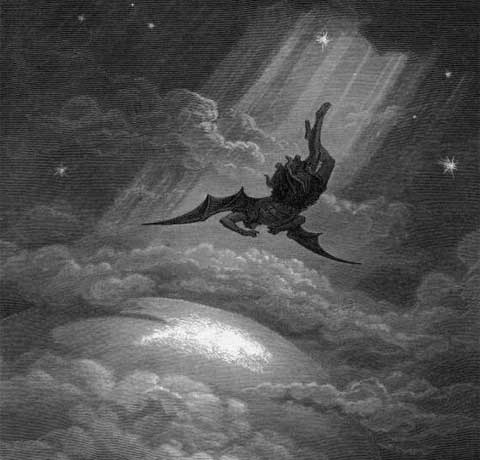
The devilish narrator reveals that after his prolonged iniquitous fall, ‘the one with all the special effects’ from God and Heaven, now there’s a new deal on the table. You instantly wonder what deal could this be and what significance it could have for the rest of the world and for the rest of the universe’s fate. You get the picture of a divine Noel Edmonds (and you have to admit he is freakishly Jesusish) sort of bloke saying ‘Deal or no deal?’

The new deal that Gabriel (‘once a carrier pigeon always a carrier pigeon’) brings down to the Satanic Majesty from the Platonic Majesty is that the fallen angel will be given a last chance at redemption, given that he agrees to spend a month in earthly personification without sin. This vacant body belongs to one Declan Gunn (notice the anagram of Glen Duncan?), a writer who is both unsuccessful and on the lip of suicide. Lucifer agrees because till now he has only kept himself busy by creating dark pleasures but has been unable to participate in his sinister creations. And so begins the one month long test-ride of what earth has to offer to and in flesh and blood.

The first few days that Lucifer spends in Declan’s body are run of the mill experiences of the anthromorphic kind. He delights in having his omnipresent and infinite knowledge cocooned in the earthly body as it is a new feeling for him. He starts tasting all that earth has on the menu and to which he had no access to as an angel. Even a fallen one. He revels like a child on the simplest earthly offerings of tastes, drink, sunsets and London. Then he goes from first gear right to the fifth and participates in decadence of a higher degree. Cocaine laced nights, gamboling with girl-escorts, even a homo-sexual encounter with a young boy…he wants to try everything he can.

But the tale is not all of Lucifer’s probation in the human sensorium; responsibility comes in as well. He has to battle with Declan’s dormant conscience and decides to resurrect the writer’s career by re-writing the story of Creation in a film-script format that has Tinsel town kissing his feet. He also rekindles Declan’s love life and also sorts out his relationship with Penelope, his much hated and much missed ex, by seeing her in person and forgiving her for cheating on him.
The novel is quite remarkable for the ventriloquism that Duncan applies to present his own observation of the human condition. What starts as a wise-cracking Lucifer introducing himself as a maverick and rebellious free-thinker and God as a humourless despot, soon turns Lucifer into renovated evil.
Till the present day, Lucifer has justified his grudge against God by using freedom as an issue. He says, ‘the point my dears, is not good nor evil - but freedom. For an angel there is only one true freedom, and that, I'm sad to say, is freedom from God. Freedom is the cause and effect. In this particular Creation, freedom from God (worship of God, dependency on God, obedience to God), is what you're after, then I'm afraid evil's for only the really game in town. What I'd like, what I'd love, is to have been given a nature that didn't even know God - the fish in the pond who doesn't know life beyond it; the lawn, the house, the city, the country, the world...’
This libertarian tone is later lost in the novel when Lucifer’s holiday in flesh sees him pondering freewill, theology and the Fall. He understands the mechanics and reason of God’s universe better in Declan’s human body which was perhaps God’s initial plan. He even contemplates about maybe getting back on God’s good side. But these are just passing thoughts and at the end of his trial month when the Archangels are back to retrieve him, the inhuman Lord wishes to remain human. However, the creator has a trick up His sleeve and the climax is quite exciting.
I, Lucifer is evil personified but personified rather well. Duncan’s prose is quite refreshing and the tone of the protagonist is well driven and subterranean. The language of this devilish monologue is witty and makes reference to all sorts of historical and popular culture events i.e. all the events in which Lucifer was involved. The book shows us the lighter, darker, opinionated, flexible, selfish, self-less, emotional and cold sides of Lucifer all at once and is as such, a must read for any reader who doesn’t mind challenging religion. To those who complain about the book being quite evil, anti-religious and dark all I can say is that it is quite expected of the Prince of Darkness to be dark in his expression. The Devil can quote scriptures to suit his purpose and Glen Duncan is one such devil. The subsequent movie based on the movie is set to release later this year.

Calvin: Do you believe in the Devil? You know a supreme evil dedicated to the temptation, corruption and destruction of man?
Hobbes: I’m not sure man needs the help.
Calvin & Hobbes